
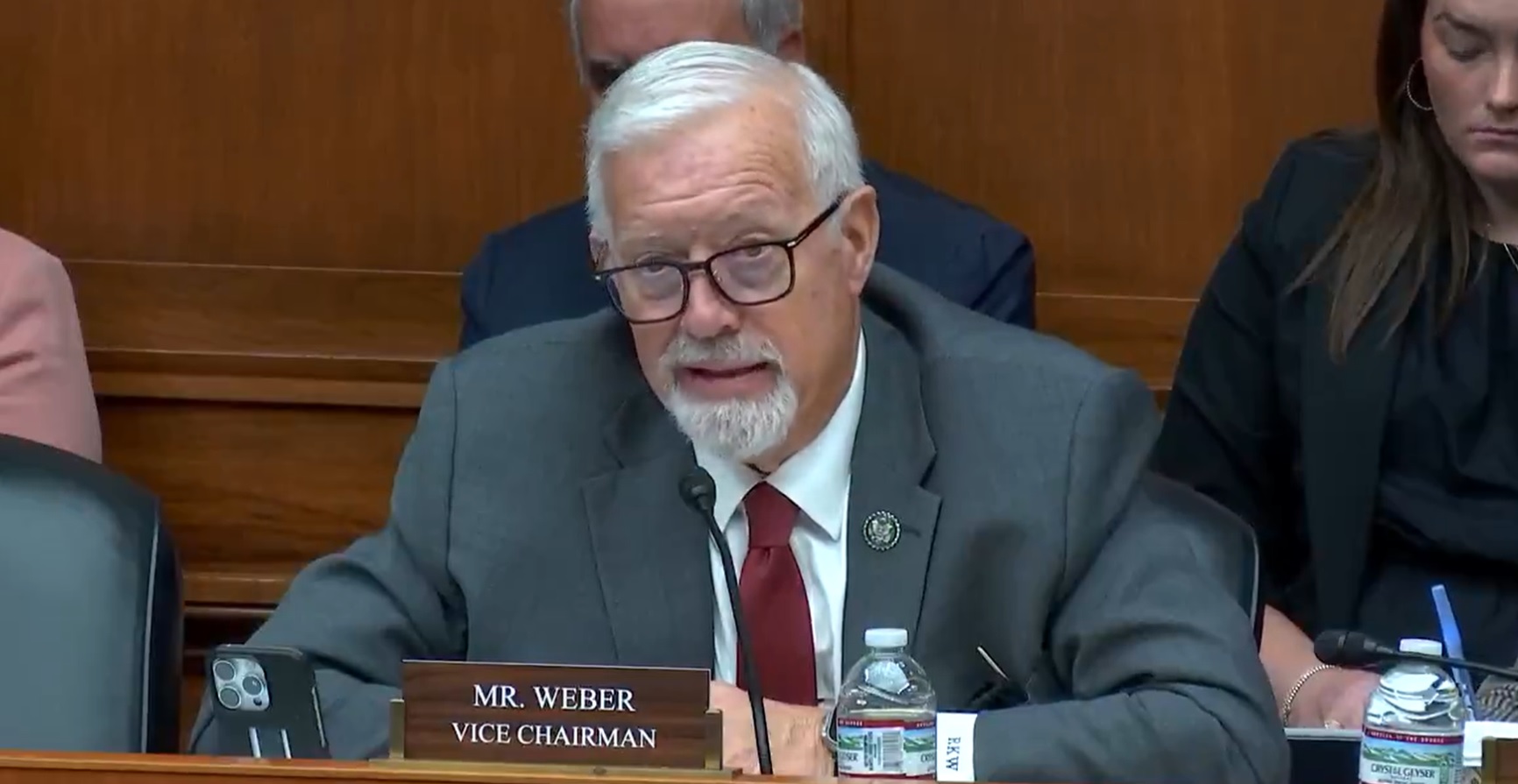
On Sept. 16, Rep. Randy Weber (R-Texas) spoke about H.R. 3474, the Federal Mechanical Insulation Act, during a Subcommittee on Energy hearing.
If passed as written, the FMIA will advance federal energy efficiencies, save tax dollars and reduce energy loss and emissions. It will also add an important audit metric for regulators to include when assessing federal buildings’ measure of Mechanical Insulation efficiencies.
During the hearing, Weber stressed the magnitude of the bill he sponsored and the astronomical numbers it could help reduce.
“According to the Government Accounting Office report, the federal government is the single largest energy consumer in the United States, with about 350,000 federal buildings, which use over 344 trillion BTUs of energy and 119 billion gallons of water in 20221 alone,” he said.
“GAO also found that only one out of 27 government agencies actually used the GAO’s government accountability tracking system,” Weber said. “Only one agency met the government’s water and energy use evaluation requirement meaning, bottom line, that taxpayer dollars are being wasted.”
Watch as @TXRandy14 discusses his legislation to address energy usage in federal buildings.
It’s time to make sure that the federal government is not wasting taxpayer dollars because of insufficient infrastructure. pic.twitter.com/bCFzeJAi90
— Energy and Commerce Committee (@HouseCommerce) September 16, 2025
The Federal Mechanical Insulation Act would add an assessment of whether Mechanical Insulation should be updated or installed during comprehensive energy and water evaluations for federal buildings. It also defines mechanical insulation properties as products that meet the ASHRAE Reference Standard 90.1.
Weber, who owned an air conditioning company for over 35 years, has seen energy requirements change, but pointed out that one major item has never been looked at, which is costing taxpayers money.
“I’ve watched all the energy requirements change for years,” he said. “When you’re evaluating the Seasonal Energy Efficiency Rating, you need to take into account the loss of energy in the duct system. The government has never done that. They’ve looked at the condensing unit, the gas furnace, the evaporating coil, but never have looked at the Mechanical Insulation on the duct work.”
“It is a gap in the current auditing scope,” said Jeff Novak, Acting General Counsel and Principal Deputy General Counsel, U.S. Department of Energy, as he replied to a question from Weber during hearing.
A relatively unknown feature outside of the construction industry, properly installed Mechanical Insulation can make an impact on budgets.
It provides large-scale and long-term energy efficiency, emissions reductions, cost savings and safety benefits at manufacturing facilities, power plants, refineries, hospitals, universities and government buildings, while creating thousands of American jobs. Nearly all Mechanical Insulation is manufactured in the U.S.
Beneficial to every sector, Mechanical Insulation is a time-tested technology that offers a quality Return On Investment.
When Mechanical Insulation is properly installed, it immediately protects buildings or facilities from problems down the line. Since Mechanical Insulation controls temperature and moisture, workers inside a facility are protected from exposure to mold and other potential bacterial diseases.
Applying Mechanical Insulation to mechanical systems or other industrial systems and components ensures their longevity. By reducing moisture buildup and regulating temperature, Mechanical Insulation helps protect industrial equipment from rust while helping it run more efficiently.
The investment in Mechanical Insulation in an industrial building or facility offers a great monetary return. From minimizing energy losses to reducing safety risks due to mold, Mechanical Insulation provides savings from day one.
If passed and signed into law, the FMIA will save taxpayer dollars by requiring all federal buildings to regularly undergo an energy audit that examines the Mechanical Insulation. If the audits reveal missing, damaged or incorrect specifications for Mechanical Insulation, these items will be corrected. In the end, the federal government will use less energy and save taxpayer money on energy bills.
Additional savings will occur as Mechanical Insulation can help extend the life of mechanical systems by limiting lost energy. This means the system will not work as hard and will likely last longer than a mechanical system that has been regularly pushed hard for years.
Visit our page for more information on the FMIA.