
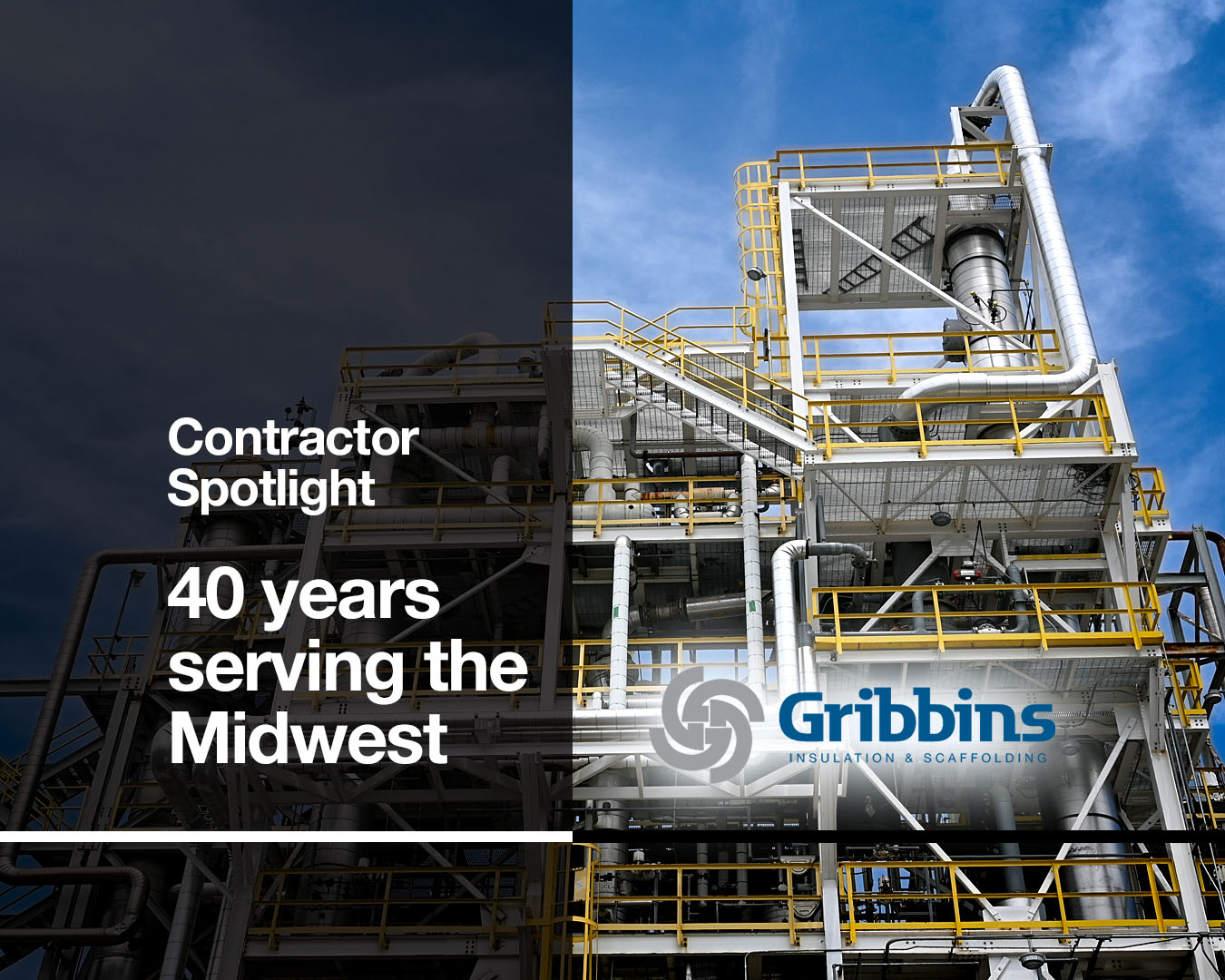
Mechanical insulation and firestopping are often behind-the-scenes construction work, but on modern projects, they are major drivers of energy performance, safety and long-term operating cost control.
The first edition of “Mechanical Insulation in Action: Contractor Spotlight” features Gribbins Insulation & Scaffolding, an LMCT-affiliated contractor that celebrated its 40th anniversary last year. Gribbins Insulation & Scaffolding is part of Gribbins Specialty Group, a family of companies providing insulation, scaffolding, abatement and industrial cleaning services throughout the Midwestern United States and beyond. Based in Evansville, Ind., the company operates branch offices in Indiana, Kentucky, Tennessee and Ohio and employs approximately 450 individuals across its service area.
Megan Knoll, SHRM-CP, Vice President of Operations at Gribbins, shared the values that she believes set their work apart: Measurable efficiency gains, a safety-first culture and the stability and quality that come with employing a highly trained union workforce.
Why Gribbins matters: Efficiency, sustainability and performance
Properly installed mechanical insulation plays a critical role in reducing energy loss, improving system performance and lowering operating costs.
“Our work helps owners achieve energy efficiency targets, supports sustainability initiatives and extends the life of mechanical systems, often with one of the strongest returns on investment in a building,” said Knoll.
In many facilities, properly specified and installed mechanical insulation delivers one of the strongest returns on investment in the building, as it improves performance years after the project is complete.
A safety culture that protects people and projects
At Gribbins, safety is not a slogan; it is a core value that shapes training, planning and daily jobsite behaviors. The company’s approach is rooted in a simple belief: Every employee deserves to go home safe at the end of the day.
A strong safety culture benefits more than the workforce; it also benefits customers and project timelines. When safety is embedded in planning and execution, it leads to:
- Better coordination and jobsite planning
- Fewer disruptions and preventable incidents
- Less downtime
- More consistent productivity
“For our customers, that means fewer incidents, less downtime and projects that stay on schedule,” said Knoll. “Safety and efficiency go hand in hand.”
Why education and awareness matter for owners and engineers
Mechanical insulation delivers outsized benefits that are still overlooked in some project conversations. Gribbins emphasizes the importance of raising awareness among owners, engineers and decision-makers because when the value is understood, better decisions follow, Knoll said.
When stakeholders recognize the impact of mechanical insulation on energy efficiency, personnel protection and long-term lifecycle costs, the ROI becomes clear.
“Once owners and engineers understand the ROI on properly insulated mechanical systems and equipment, the decision to move forward is truly a no-brainer,” she added.
The union workforce advantage: Training, stability and dependable execution
Knoll highlighted a straightforward truth: A highly trained union workforce brings proven training, consistency and a strong commitment to safety and quality. That translates into:
- Skilled craftsmanship
- Fewer errors
- Dependable project execution
Another key advantage is stability. Union benefits play an important role in creating safer, more productive jobsites. When workers have reliable pay, healthcare for their families and a secure retirement, they are less stressed and more focused on the work in front of them.
That stability supports:
- Better decision-making
- Stronger attention to safety
- More consistent productivity
“In short, a union workforce is a stable, well-trained workforce, which is a safer, more efficient workforce,” Knoll said.
Long-term owner value: Lifecycle cost control and reduced risk
Quality mechanical insulation and firestopping deliver value well beyond initial construction.
“Properly installed mechanical insulation improves system efficiency, saves energy costs and reduces maintenance needs, delivering long-term value well beyond initial construction,” said Knoll.
For owners and general contractors, that level of training and quality reduces risk. The benefits show up as:
- Fewer callbacks
- Less rework
- Better schedule certainty
- Confidence that the work is done right the first time
Workforce development: essential to the future of the trade
Workforce development is central to the future of Gribbins and the mechanical insulation industry as a whole.
“Investing in career awareness, innovative recruiting and high-quality training ensures we have the skilled professionals needed to meet growing demand and maintain the high standards our customers expect,” Knoll said.
Why Gribbins’ work matters to customers, the industry and communities
At the end of the day, Gribbins’ work matters because it protects people, conserves energy and supports critical infrastructure.
As a union contractor, Gribbins helps create and sustain stable, well-paying jobs that support families and communities, Knoll said.
“Providing that level of security for our workforce allows our teams to show up focused, committed and proud of the work they do, benefiting our customers, the industry and the communities we serve,” she emphasized.
To learn more or to receive a quote on your next mechanical insulation project, please visit the Gribbins website for more information.