
The Insulators LMCT has applied to partner with U.S. Department of Energy (DOE) to raise awareness and educate school communities about improving heating and cooling systems and increasing building energy efficiency.
As a nonprofit organization, the LMCT can provide several levels of support, including independent consultation, technical guidance, specification-compliance assistance, access to Mechanical Insulation Energy Audit (MIEA) teams and advocacy.
These services will help ensure that modern mechanical insulation systems in schools are used effectively rather than removed by individuals or organizations that may not fully understand their value. “Value engineering” often emphasizes short-term cost reductions at the expense of energy efficiency, which ultimately works against the client’s needs.
The potential partnership is tied to a DOE announcement to provide up to $100 million for a new school energy program. The program will help public school districts cut facility operating costs, make essential building systems more reliable and build financeable improvement plans that attract both public and private investment. The funding opportunity comes from DOE’s Office of Critical Minerals and Energy Innovation (CMEI).
“Every student deserves a comfortable place to learn, and every school should have the resources to make that possible,” said Asst. Secretary of Energy Audrey Robertson. “Under President Trump’s leadership, we are helping school districts make practical improvements that enhance learning environments, lower energy costs and allow districts to focus resources where they matter most.”
How the A+STEPS School Energy Program Works
The competitive Affordability + Strategic Energy Pathways for Schools (A+STEPS) opportunity is part of DOE’s $500 million Renew America’s Schools Program, which funds energy improvements at K–12 public schools across the country. The program helps school communities complete upgrades that lower energy costs and create healthier learning environments.
In the first phase of A+STEPS, DOE expects to select four to eight regional hubs. Each hub will receive $2 million to $5 million per funding round to train school facility staff, coordinate technical providers and give districts access to tools and data. EnergyWerx manages the program in partnership with DOE, and the application process for school districts and partners is expected to open in November.
Why Older School Buildings Struggle With Energy Efficiency
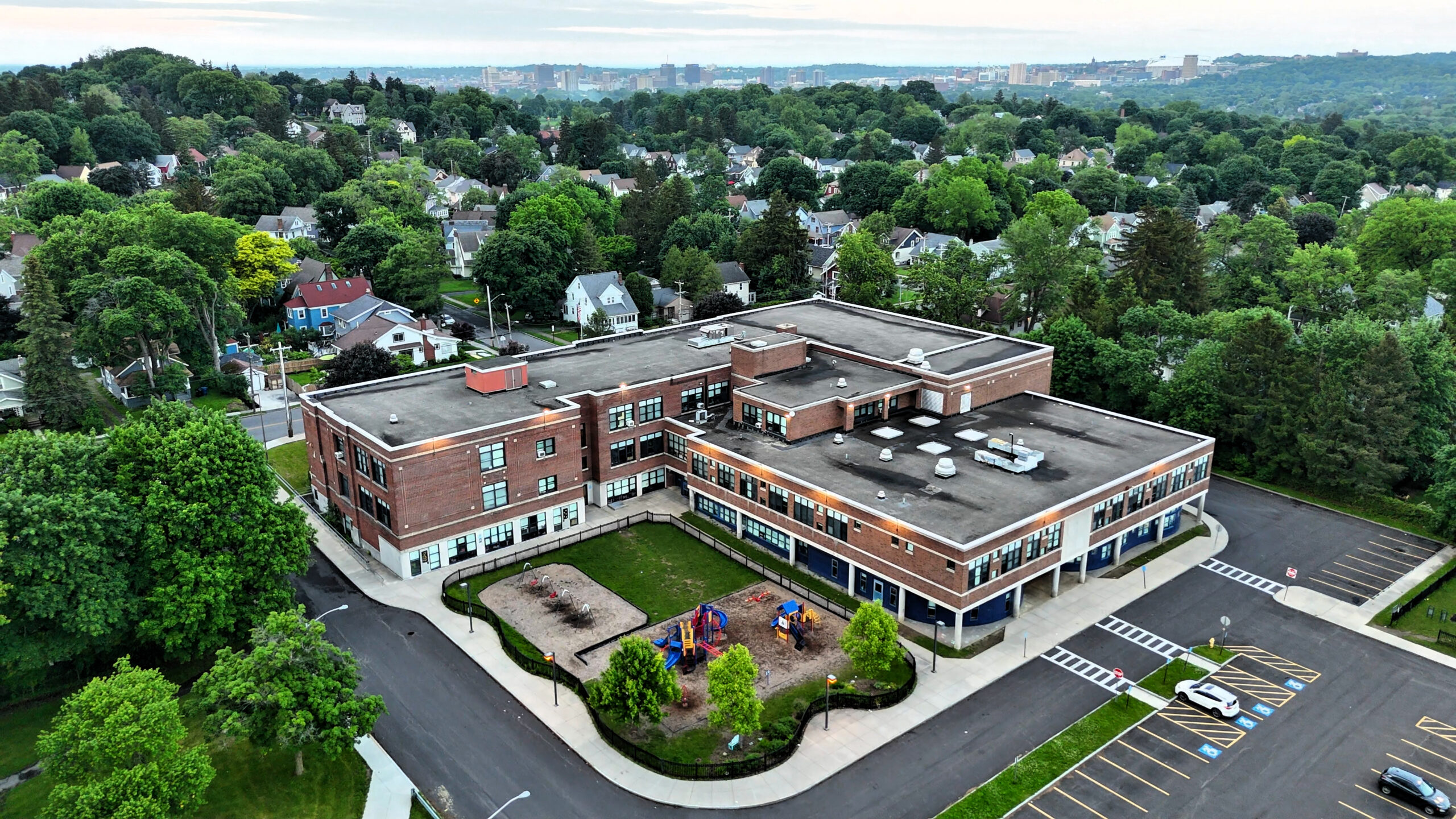
The average primary instructional building at a U.S. public school is 49 years old, and 38 percent were built before 1970, according to the National Center for Education Statistics. Many of these buildings were constructed before modern energy codes required insulation.
Older schools often rely on concrete block, brick, and tile for durability and fire resistance. These materials readily transfer heat, so without insulation, they let cold in during the winter and heat in during the summer. In many older buildings, no insulation layer exists at all.
HVAC systems add to the challenge. Schools must bring in large volumes of outdoor air to ventilate densely occupied classrooms, and that air has to be heated or cooled before it reaches students. High ceilings and heavy masonry also make stable temperatures harder to maintain. A U.S. Government Accountability Office survey estimated that 41 percent of school districts need to update or replace HVAC systems in at least half of their schools, or about 36,000 schools nationwide. Properly specified and installed mechanical insulation on piping, ductwork, and equipment helps these systems deliver heating and cooling where it is needed instead of losing energy along the way.
A+STEPS Aligns With the Federal Mechanical Insulation Act
Schools nationwide must operate their utility systems efficiently to maintain safe environments and use taxpayer funds responsibly.
“This initiative aligns closely with our Federal Mechanical Insulation Act, H.R. 3474 and S. 4312, which seeks to ensure that more than 350,000 federal buildings properly use mechanical insulation to conserve energy and promote responsible financial stewardship,” said Pete Ielmini, LMCT Executive Director. “The International Association of Heat and Frost Insulators and Allied Workers and its signatory contractors provide the nation’s leading technical workforce to address the lack of insulation expertise in school districts.”