

The Insulators LMCT brought a clear message to the Firestop Contractors International Association (FCIA) Firestop Industry Conference and Trade Show (FIC ‘26) held in Fort Worth, Texas, Nov. 2-5. Union mechanical insulation contractors and their workforce are ready to deliver code-compliant firestop installations across North America.
The firestop industry is well established, but building owners, manufacturers and specifiers may not realize that the International Association of Heat and Frost Insulators and Allied Workers (HFIAW) represents more than 25,000 skilled workers trained in firestop applications and backed by a strong safety record.
Connecting the Industry With Trained Firestop Installers
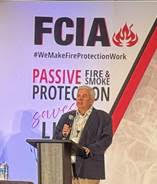
LMCT Senior Mechanical Insulation Specialist Jim Petrides, CEM, CEA, CTII, CIEA, staffed the LMCT’s booth and presented during the conference. His goal was to connect manufacturers and building owners with union firestop contractors who can deliver high-quality installations that meet code.
“The participation of the Insulators LMCT at FCIA’s annual conference provided the LMCT an opportunity to promote the Insulators trained workforce as a source of highly trained installers available throughout the U.S. and Canada,” said Petrides. “Together, our partnership with our specialty contractors provides exceptional firestop life safety solutions throughout the built environment, at a great value for the customer.”
What Is a Firestop System?
A firestop system blocks fire, smoke, and toxic gases from spreading through openings and joints in fire-rated walls, floors and ceilings.
Firestop materials alone are not a complete system. To work as designed, they must be installed according to strict, tested specifications. Improper installation can cause the system to fail, leading to property damage and loss of life.
Common firestop products include:
- Fire-resistant sealants, caulks and putty
- Mortars, pillows and blocks
- Plastic-pipe collars with intumescent materials that expand when exposed to heat
Why Firestopping Matters in Every Building
Every time pipes, cables or ducts pass through a fire-rated wall or floor, they leave gaps that fire and smoke can travel through. Firestopping seals those penetrations and help preserve the assembly’s fire-resistance rating.
For example, when a plumbing contractor drills through a fire-rated wall to run pipe, the opening around that pipe must be sealed with an approved firestop system. Without it, the wall may no longer provide its intended protection.
Properly installed firestop systems:
- Slow the spread of fire between rooms and floors
- Restrict smoke movement
- Protect occupants during evacuation
- Maintain fire-rated compartments
- Satisfy requirements in most building and fire codes
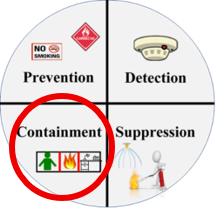
Firestopping works alongside other building-safety technologies, including smoke control, as part of a layered approach to protecting lives and property.
Firestopping vs. Fireproofing: What is the Difference?
The two terms are often confused, but they serve different purposes:
- Firestopping seals openings and joints to keep fire and smoke from spreading through walls and floors.
- Fireproofing protects structural components, such as steel beams, so they can withstand fire for a specified time.
Skilled Union Labor for Life Safety Work
Since firestop systems only perform when installed correctly, the skill of the installer matters. The HFIAW’s rigorously trained workforce, available throughout the U.S. and Canada, gives contractors, manufacturers and building owners a reliable source of qualified labor for this critical life-safety work.
Learn more about LMCT firestop and smokeseal services or find a firestop contractor near you.